The Pre-Anesthesia Evaluation Center (PEC) at NewYork-Presbyterian/Weill Cornell Medical Center is an integral part of a patient’s peri-procedural journey. The PEC team analyzes the medical records of all patients undergoing a procedure involving anesthetics in order to optimize patient care prior to the procedure or surgery. The information we gather from various sources is organized and documented for the day-of-procedure anesthesia care team. We contact patients to clarify their health status and advise on perioperative medication management and preoperative interventions to optimize outcomes. Last year, the PEC team reviewed more than 70,000 patient charts to ensure safe and timely care.
The PEC team’s comprehensive data collation contributes to perioperative management in several important ways:
- We identify potential health factors that may need to be optimized prior to surgery.
- We mitigate anesthetic risk during a procedure.
- We optimize a patient’s health before, during, and after a procedure.
As a result of the pre-anesthesia team’s expertise, less than 0.1% of surgeries at Weill Cornell Medicine are rescheduled on the day of the procedure due to lack of medical optimization. This is well below the national average of 4-12%.
While the PEC team can care for the vast majority of patients with chart review and a phone call, we also offer in-person visits. These more personalized visits offer patients an opportunity to be evaluated by one of our expert team members, ask questions directly to an anesthesiologist about a personal care plan, discuss concerns, and have relevant lab testing conveniently done in our clinic.
Who We Are
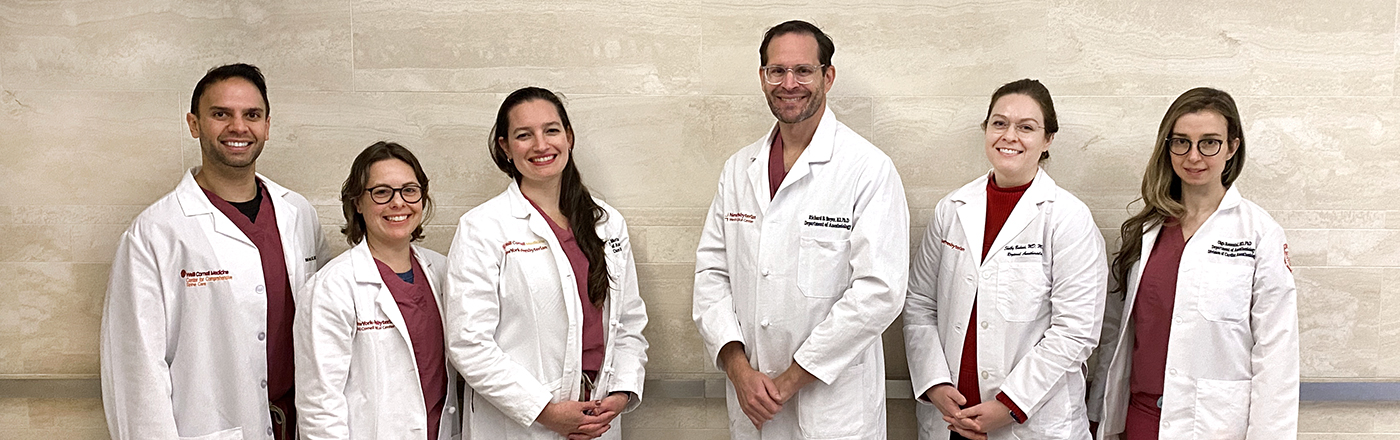
The PEC staff includes fourteen nurse practitioners, five nurses, a medical-surgical technician and two business associates. Nine attending anesthesiologists staff the clinic in rotation full time performing consultations, answering questions, talking to patients, and facilitating optimization of patients’ health status.
Expanding Role of Pre-Anesthesia Clinic
The PEC serves as an important safety net throughout the peri-procedural period. Because anesthesia can be affected by any organ-system, we recognize the value of understanding all the health issues a patient is experiencing, not only the ones that are technically relevant to the surgery.
We are also building a risk optimization toolbox to facilitate best decision-making and ensure patients receive world-class care. One innovation is that we now text guidance to patients about what medications they need to hold prior to a procedure. Additionally, a new matrix offers guidance to proceduralists on what pre-procedural testing is recommended to ensure that patients are neither over- nor under-tested prior to a procedure. We are expanding optimization programs that have been shown to improve outcomes in the areas of iron deficiency anemia, frailty, and smoking cessation.
Faculty

Richard Boyer, MD, PhD
Director, Pre-Anesthesia Evaluation Center (PEC)
Fun-Sun Frank and Baw-Chyr Peggy Yao Research Scholar in Anesthesiology
Director, Medical Accelerator and Digital Engineering
Assistant Professor of Anesthesiology